
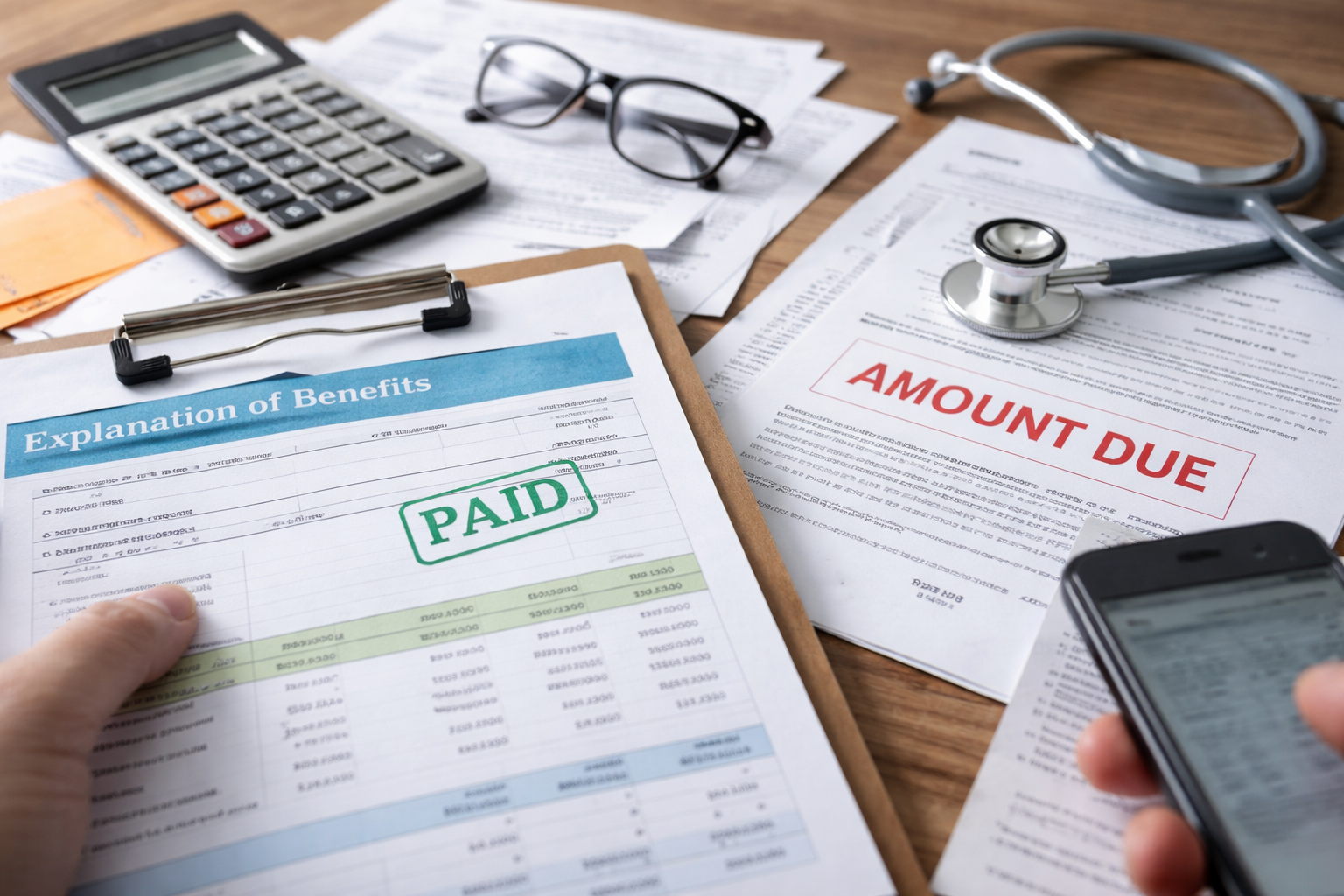
Insurance EOB Shows Paid But Patient Still Billed — I noticed it in the worst possible way: a “FINAL NOTICE” style envelope sitting on the kitchen counter. I opened it expecting a routine statement, but the balance was still there. The problem was I had already checked my insurer’s portal the night before. The claim status showed “Paid.” The EOB looked clean. The payment date was listed. The provider was still billing me anyway.
Insurance EOB Shows Paid But Patient Still Billed is the kind of mismatch that makes you doubt your own screenshots. It feels like someone is asking you to pay twice, and the language on the EOB doesn’t make it obvious what “paid” actually refers to. The fix is usually not complicated, but it is very specific: you have to identify which part of the claim cycle is out of sync and then talk to the right team with the right numbers.
If you want a quick refresher on the claim pipeline before you start calling anyone, this internal workflow guide will make the rest of this page easier to follow.
Start Here: What “Paid” Usually Means on an EOB
Insurance EOB Shows Paid But Patient Still Billed often starts with a simple misunderstanding: “paid” is not the same as “you owe nothing.” An EOB is a processing summary generated by the insurer’s claim system after adjudication. It shows how the claim was priced and how responsibility was assigned.
Before you do anything else, locate these fields on the EOB:
- Allowed amount (the negotiated or plan-determined price)
- Plan paid (what the insurer issued)
- Patient responsibility (deductible, coinsurance, copay, or non-covered)
- Remark codes (short notes like “applied to deductible” or “non-covered”)
If patient responsibility is not $0, the provider can bill you even when the claim shows “paid.” That’s the most common reason Insurance EOB Shows Paid But Patient Still Billed appears.
Fast Self-Check: Match the Bill to the EOB in 2 Minutes
When Insurance EOB Shows Paid But Patient Still Billed hits, you can usually categorize it quickly by matching numbers.
Self-check checklist
- Does the provider’s “amount due” equal the EOB’s patient responsibility?
- Does the provider bill show the allowed amount or the original billed charge?
- Does the bill list a payment or adjustment from insurance, even if the balance remains?
- Is the date of service the same as the EOB’s date of service?
- Is the provider name on the bill exactly the same as on the EOB (group vs individual matters)?
If the bill amount matches patient responsibility, Insurance EOB Shows Paid But Patient Still Billed is usually legitimate cost-sharing. If it does not match, you likely have a posting error, split claim issue, wrong payee, COB surprise, or a reprocessing event.
Identify Your Exact Scenario
Insurance EOB Shows Paid But Patient Still Billed is not one problem; it’s a family of problems. Use the branches below to find the fastest path.
Branch A — Deductible / coinsurance correctly applied Most common scenario. The claim is marked “paid” because the insurer processed it and issued their portion (or issued $0 with pricing applied). The remaining balance is assigned to you as deductible or coinsurance.
How to confirm: EOB patient responsibility equals (or nearly equals) the provider’s amount due. Remark code often mentions deductible, coinsurance, copay, or plan limitations.
What fixes it: Usually nothing to “appeal” unless services were priced incorrectly, processed out-of-network incorrectly, or a benefit should have applied differently.
Branch B — Provider billed before insurance payment posted Insurance EOB Shows Paid But Patient Still Billed happens when the insurer issued an EFT/check, but the provider ledger hasn’t posted it yet. Providers run statements on schedules; payments post on different schedules.
How to confirm: EOB shows plan paid amount; provider bill shows $0 insurance payment line, or the payment line is missing. Service date is recent (often within 7–21 days of EOB).
What fixes it: Ask provider billing to “re-run the claim reconciliation” or “check remittance posting” using the insurer’s payment trace number or EFT date.
Branch C — Payment went to the wrong entity (wrong NPI / group / payee)Sometimes the insurer pays a related provider group, an old tax ID, or a clearinghouse route that doesn’t land in the exact billing account that generated your bill.
How to confirm: EOB names a different payee or provider group than the bill. Provider insists they have no record of payment even though insurer shows “paid.”
What fixes it: Insurer issues a payment “re-direction” or void/reissue. Provider billing must confirm the correct billing entity and NPI/tax ID they used on the claim.
Branch D — Split claims and partial processing A single visit can create separate claims (facility, physician, anesthesia, lab, imaging). Insurance EOB Shows Paid But Patient Still Billed can be true for one claim line while other parts are pending or denied.
How to confirm: EOB shows payment for only some CPT codes or only one claim number. Provider bill references a different claim number or lists multiple service components.
What fixes it: Ask provider for the full itemized statement and claim numbers. Then match each claim number to an EOB. You’re looking for the one that’s missing or pending.
Branch E — Coordination of Benefits (COB) changed after the fact COB is a common reason Insurance EOB Shows Paid But Patient Still Billed suddenly appears weeks later. The insurer may initially pay, then later reverse or reduce when another insurer is considered primary.
How to confirm: The portal shows payment history changes, reversals, or adjustments. Remark codes reference COB, other coverage, or “paid as secondary.”
What fixes it: Update COB with the insurer, confirm primary/secondary order, and request reprocessing. If a reversal already happened, the provider may rebill you until COB is resolved.
Notice how each branch changes who needs to act first. That’s why Insurance EOB Shows Paid But Patient Still Billed can waste weeks if you start with the wrong phone call.
What to Say on the Phone (So You Don’t Get Ping-Ponged)
Insurance EOB Shows Paid But Patient Still Billed calls often go nowhere when you ask “Why am I being billed?” A better approach is to anchor the conversation in identifiers the systems recognize.
Provider billing script (short, effective)“I’m calling about a bill for date of service [MM/DD]. My insurer’s EOB shows the claim is paid under claim number [X]. Can you tell me whether the insurance payment posted to my account, and if not, can you check remittance/EFT posting for the payment date [X]?”
Insurer script (short, effective)“My provider is billing me, but my EOB shows paid. Can you confirm the payment method (EFT/check), the payee name, and provide the payment trace number and amount? I need to confirm where the payment was sent.”
Your goal is to get a trace number and a payee name. That pair solves a large share of Insurance EOB Shows Paid But Patient Still Billed cases because it turns the issue into a posting/reconciliation task, not a debate.
When “Paid” Is Real but the Amount Is Still Wrong
Sometimes Insurance EOB Shows Paid But Patient Still Billed is not a posting issue. The insurer did pay, but the pricing or benefit application is wrong. Examples:
- The claim was processed as out-of-network when it should be in-network
- The allowed amount looks wrong for your plan and facility type
- A preventive benefit was priced like diagnostic
- A modifier caused a reduced payment unexpectedly
In these cases, you often need a structured appeal or reconsideration, not just a provider correction. If your situation looks like an underpayment after reprocessing or appeal, this guide is the closest match.
Insurance EOB Shows Paid But Patient Still Billed becomes urgent when the provider is billing you for an amount that is not consistent with the EOB’s responsibility section. That mismatch is the signal that the claim and the provider ledger are describing different realities.
What You Can Ask For (Patient Rights Without Overpromising)
Insurance EOB Shows Paid But Patient Still Billed situations are stressful, but there are concrete requests you can make that don’t require legal threats.
- Ask the provider for an itemized bill and the claim number(s) submitted to insurance.
- Ask the insurer for the EOB with remark codes and the payment trace number.
- Ask the provider to place a temporary billing hold while payment posting is verified.
- Ask both sides to confirm the billing entity/payee (group vs individual) tied to the claim.
These are standard operational requests. They are not “special favors,” and they align with how claims and billing teams actually work.
Do Not Do These Things (They Commonly Backfire)
Insurance EOB Shows Paid But Patient Still Billed gets worse when people take actions that lock in the wrong record.
- Don’t pay the full bill immediately if the EOB responsibility doesn’t match the amount due.
- Don’t file an appeal blindly before confirming whether it’s a posting issue or a pricing issue.
- Don’t ignore the bill assuming “paid” means closed; ask for a hold if needed.
- Don’t accept “we don’t see it” without asking for claim/payment identifiers and dates.
The fastest path is matching identifiers, not arguing about who is “right.”
If It Escalates: Audit, Reopen, or Retro Denial Signals
In a smaller set of cases, Insurance EOB Shows Paid But Patient Still Billed is a symptom of a claim that changed after payment. Warning signals include new adjustments, payment reversals, “review” notes, or letters requesting records.
If your insurer mentions audit or review language, this page is the best next read because the workflows and timelines differ.
Key Takeaways
- Insurance EOB Shows Paid But Patient Still Billed usually means the insurer processed the claim, not that your balance is zero.
- The quickest diagnosis is matching the provider “amount due” to EOB “patient responsibility.”
- Posting delays and wrong payee issues are common and solvable with a payment trace number.
- Split claims can make one component look paid while another component is still pending or billed.
- When the numbers don’t match, treat it as a reconciliation problem first, not an appeal.
FAQ
Why does Insurance EOB Shows Paid But Patient Still Billed keep happening even after I call?
Because one call rarely moves both systems. You typically need (1) the insurer’s payment trace number and payee name and (2) the provider’s confirmation of whether that payment posted to your specific account ledger.
Is it normal that the EOB says “paid” but I still owe deductible?
Yes. Insurance EOB Shows Paid But Patient Still Billed often reflects deductible or coinsurance. Confirm by checking the patient responsibility line and any deductible remark codes.
What if the provider bill amount is higher than my EOB patient responsibility?
That mismatch is exactly when Insurance EOB Shows Paid But Patient Still Billed becomes a correction issue. Ask for an itemized bill and have the provider confirm they applied the insurer’s allowed amount and adjustments.
Should I dispute the bill with the provider?
Start with reconciliation: itemized statement + claim number + payment trace number. If the provider still bills above the EOB responsibility after posting, then you can discuss formal dispute/appeal paths.
What if I’m being threatened with collections?
Ask the provider for a short billing hold while payment posting is investigated, and document the claim number and EOB status. Insurance EOB Shows Paid But Patient Still Billed is often resolved before escalation when identifiers are shared quickly.
Official Source
For general, official guidance on reading EOB-style claim summaries and common patient billing issues, see CMS consumer education materials:
CMS Medical Bill Rights – Consumer Guides
Insurance EOB Shows Paid But Patient Still Billed is frustrating because the portal language sounds final. “Paid” reads like closure. In reality it often means “processed with an assigned responsibility.” Once you treat the EOB as a routing and pricing document instead of a receipt, the situation becomes easier to diagnose.
Insurance EOB Shows Paid But Patient Still Billed problems resolve fastest when you do two things in order: (1) match the provider amount due to the EOB patient responsibility, and (2) if they do not match, obtain the insurer’s payment trace number and give it to provider billing for reconciliation. That’s the step that turns a confusing conflict into a trackable transaction.
Right now, do this: pull up the EOB, write down the claim number, patient responsibility, payment amount, and payment date, then call the provider billing office and ask them to confirm whether that insurance payment posted to your ledger. If it didn’t, request a billing hold while they locate the remittance using the trace number. If the amount is truly wrong after posting, move to a targeted reconsideration instead of a general complaint.