
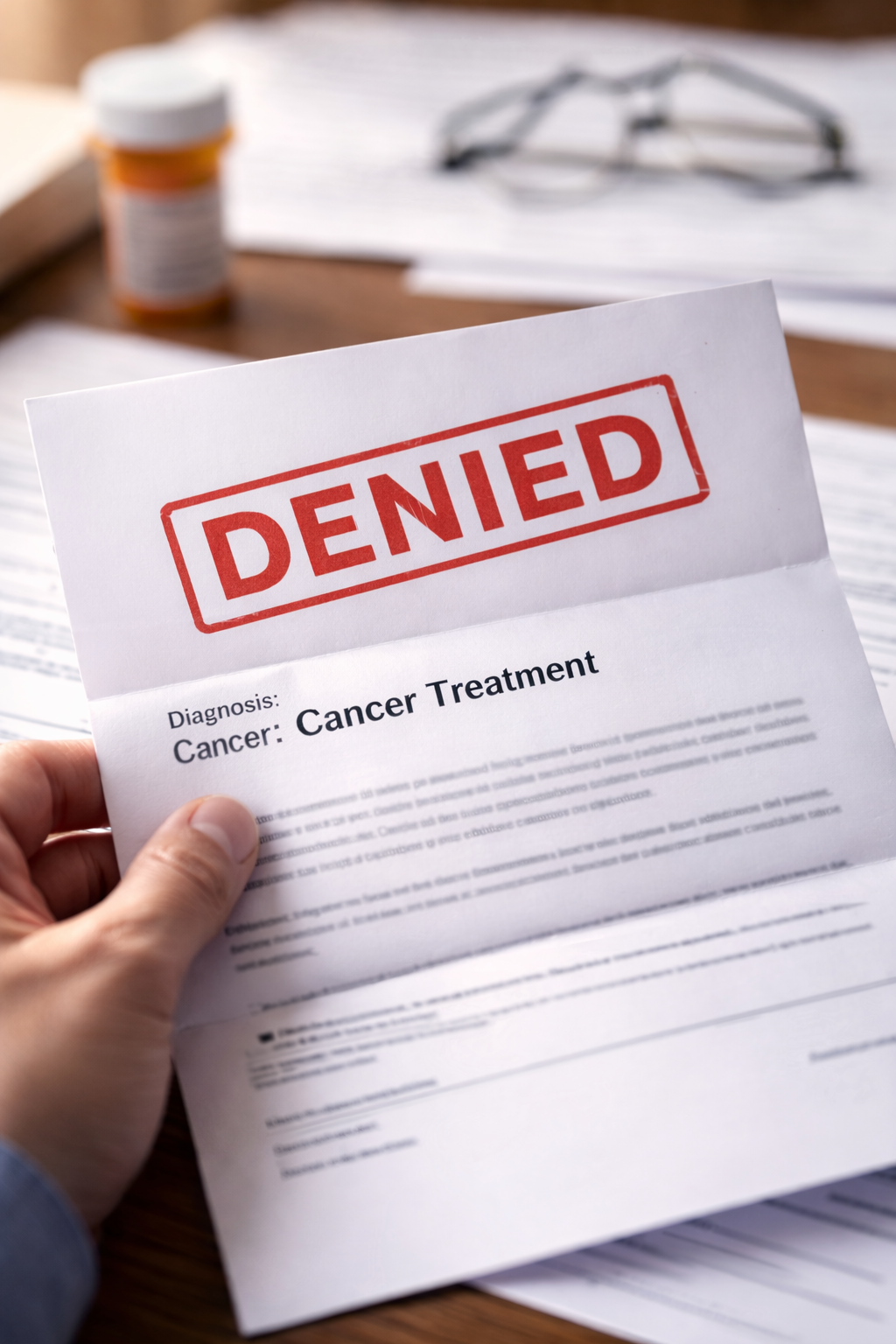
Insurance denied cancer treatment — I noticed it the way people notice bad news now: not from a phone call, but from a short alert in a portal. I clicked in, expecting a request for more information. Instead, it was a denial. A few lines. A code. A date. And the kind of language that never sounds human.
I didn’t panic. I also didn’t “accept it.” When insurance denied cancer treatment, the most dangerous mistake is waiting for the system to explain itself. The system rarely does. So I treated it like an urgent project: identify the reason, pick the correct lane, move the paperwork, and force a timeline.
What a denial usually means (and what it doesn’t)
When insurance denied cancer treatment, the denial is typically a policy decision, not a clinical judgment. It usually means the request failed to match one or more plan requirements: authorization steps, network rules, coding alignment, or documentation standards.
A denial is often a process mismatch—not a final answer. Your job is to align the request with the insurer’s rules fast enough that care does not stall.
Your first 30 minutes: do these before you call anyone
If insurance denied cancer treatment, do not start with a phone call. Start with evidence and structure.
- Download the full denial letter (PDF if available), not the summary screen.
- Find the exact denial reason and any reference numbers (authorization ID, claim ID, service request ID).
- Locate the appeal deadline and whether “expedited” review is allowed.
- Write a simple timeline: request date → denial date → next scheduled treatment date.
Write down the next treatment date first. That date controls how urgent your escalation must be.
Before you go deep, it helps to follow the complete denial workflow so you don’t miss a step. This guide is the closest “hub” for the bigger process:
Use it as your backbone, then come back here for cancer-treatment-specific urgency and case branching.
Case branches: match your denial type before you appeal
Case A: Prior authorization (PA) not approved
The insurer says approval was required first, or the PA submission was incomplete.
Case B: “Not medically necessary” (criteria-based denial)
The insurer claims your request doesn’t meet plan criteria for this diagnosis/stage/line of therapy.
Case C: Step therapy / “try X first”
The insurer requires a different medication or regimen before covering the requested one.
Case D: Network / out-of-network provider or facility
The oncologist, hospital, infusion center, or imaging site is outside your network rules.
Case E: Site-of-care restriction
The insurer approves the therapy, but only at a specific setting (e.g., outpatient vs hospital-based).
Case F: Coding / documentation mismatch
Diagnosis code, procedure code, or clinical notes don’t align with what the insurer expects.
Case G: “Experimental / investigational” label
The insurer categorizes the therapy as investigational under your policy language.
Case H: Formulary / specialty pharmacy rule
Coverage is denied because the drug must be obtained through a specific channel or formulary tier.
Case I: Timing / “pre-service vs post-service” confusion
The denial happened because the request was filed at the wrong stage (before service vs after claim).
Appeals fail when people argue the wrong case. A strong appeal is not “please help us.” It’s “here is the exact requirement you cited, and here is the evidence that satisfies it.”
Why insurers deny urgent cancer care (system logic)
When insurance denied cancer treatment, it can feel personal. But denial systems are built for consistency, not compassion. Most decisions follow a checklist:
- Was the request submitted through the correct channel (PA vs claim vs exception)?
- Does the documentation explicitly match coverage criteria (not just “needs treatment”)?
- Is the provider/facility eligible under network and site-of-care rules?
- Are coding and clinical notes consistent and complete?
Your fastest win is often correcting the “paper shape” of the request, not arguing emotionally about urgency (even though urgency is real).
Immediate action plan by case type
If insurance denied cancer treatment, pick your case and follow the corresponding “first move.”
Case A (Prior Authorization):
Ask the provider’s office for the PA submission details and what was attached. Then request a same-day resubmission with the missing elements. Many PA denials reverse quickly when the submission is completed correctly.
Case B (Medical Necessity):
You need a physician letter that explicitly maps your case to the insurer’s criteria (diagnosis, stage, prior treatments, contraindications, urgency). The appeal should cite the denial language and respond point-by-point.
Case C (Step Therapy):
Request an exception with documentation explaining why the “step” option is inappropriate (failed therapy, intolerance, contraindication). This is usually an exception pathway, not a standard claim argument.
Case D (Network):
Ask whether an in-network alternative exists with a reasonable timeframe. If not, ask about network gap exception / continuity of care pathways. Make the insurer document that timely in-network care is not available.
Case E (Site-of-Care):
Confirm whether the insurer will approve at another setting and what is required to switch. Sometimes the denial is not “no,” it’s “not there.”
Case F (Coding/Docs):
Ask for the exact mismatch. Then have the provider correct codes or attach the missing note. These are often the fastest reversals when handled precisely.
Case G (Experimental):
This is policy language heavy. Your appeal must address the insurer’s definition and why the treatment should qualify under coverage (or why an exception/external review is appropriate).
Case H (Formulary/Pharmacy):
Ask whether the denial is about where/how the medication must be filled. The fix may be a channel change, not a medical argument.
Case I (Timing):
Clarify whether you are appealing a pre-service denial (authorization) or a post-service denial (claim). The wrong appeal route can waste weeks.
Expedited review: the lever most people forget
When insurance denied cancer treatment and timing is critical, you may be able to request an expedited appeal or review. This matters because standard timelines can be too slow when treatment schedules are close.
Expedited requests should be explicit, in writing, and tied to the health jeopardy standard (your denial letter or plan documents often mention it). Ask the insurer what they need to process expedited review and document their answer.
For official rules and consumer-facing steps on appeals and external review, use this government resource:
It explains internal appeals and external review at a high level and helps you stay aligned with required steps.
A “self-apply” checklist you can use today
If insurance denied cancer treatment, use this checklist to map your exact situation in 5 minutes:
- Denial category: PA / medical necessity / step therapy / network / site-of-care / coding / experimental / formulary / timing
- Deadline: appeal due date listed on denial letter
- Urgency: next treatment date (write it down)
- What’s missing: one document you can request today (PA packet, clinical note, letter)
- Escalation path: standard appeal vs expedited appeal vs external review
If you can’t answer “denial category,” you’re not ready to appeal yet. Get the full letter and the insurer’s exact reason first.
If your appeal goes silent, don’t let time slip
In urgent cases, silence is not neutral. If insurance denied cancer treatment and your appeal is “under review” with no updates, you need a follow-up rhythm and a documented timeline. This guide helps you push the process without triggering unnecessary conflict:
Use it the moment you feel the process has stalled, especially when deadlines or treatment dates are near.
Mistakes that feel “protective” but backfire
When insurance denied cancer treatment, people often take actions that feel safe but can weaken the case or slow it down:
- Calling without documenting: phone calls vanish unless you log names, dates, and reference numbers.
- Submitting a generic appeal: “please reconsider” rarely beats criteria-based denial.
- Assuming the provider will fix everything: providers may resubmit, but you must track deadlines and outcomes.
- Skipping expedited language: urgency must be stated clearly, not implied.
- Waiting for the next notice: deadlines don’t wait for clarity.
How to communicate without triggering a fast denial
If insurance denied cancer treatment, your written message should be calm, specific, and aligned to the denial reason. The goal is to keep the insurer in “process mode,” not “defensive mode.”
- State the denial date and reference number
- State your requested review type (standard vs expedited)
- State the denial reason category you are responding to
- Ask what exact document or criterion is missing
Be firm about timelines, not emotional about motives. That approach is more likely to produce action.
FAQ
Is it normal that insurance denied cancer treatment even when the doctor recommends it?
It happens more than most people expect. Recommendations and coverage criteria are not the same. Your strongest path is matching documentation to the insurer’s stated reason.
What’s the difference between authorization denial and claim denial?
Authorization is pre-service approval; claim is post-service payment. The appeal route can differ. Appealing the wrong type wastes time.
Can I request expedited review?
Often yes, especially if delay could seriously jeopardize health. Ask explicitly and document the request in writing.
Should I stop treatment while appealing?
This is a medical and financial decision that depends on your care team and your plan. This article provides process guidance only, not medical advice.
What if the insurer asks for more time?
Ask what rule allows the extension and request updates on a defined schedule. Silence can become the problem.
Key Takeaways
- When insurance denied cancer treatment, speed and precision matter more than volume.
- Identify the denial type first; appeal arguments must match the reason.
- Use expedited review when timelines are tight.
- Document everything: letters, reference numbers, dates, and submissions.
- Do not let “no response” become an invisible denial.
If you’re reading this because insurance denied cancer treatment, the system is already moving. It’s just moving without you unless you step in. The denial letter is not the finish line. It’s the starting gun.
Your next action should be clear today: get the full denial reason, match your case type, request expedited handling if time is short, and submit the correct evidence through the correct path. You’re not responsible for the system being complicated—but you can force it to respond.
General information only; not legal or medical advice. For decisions about treatment timing, consult your treating clinicians and your insurer’s official appeals instructions.