
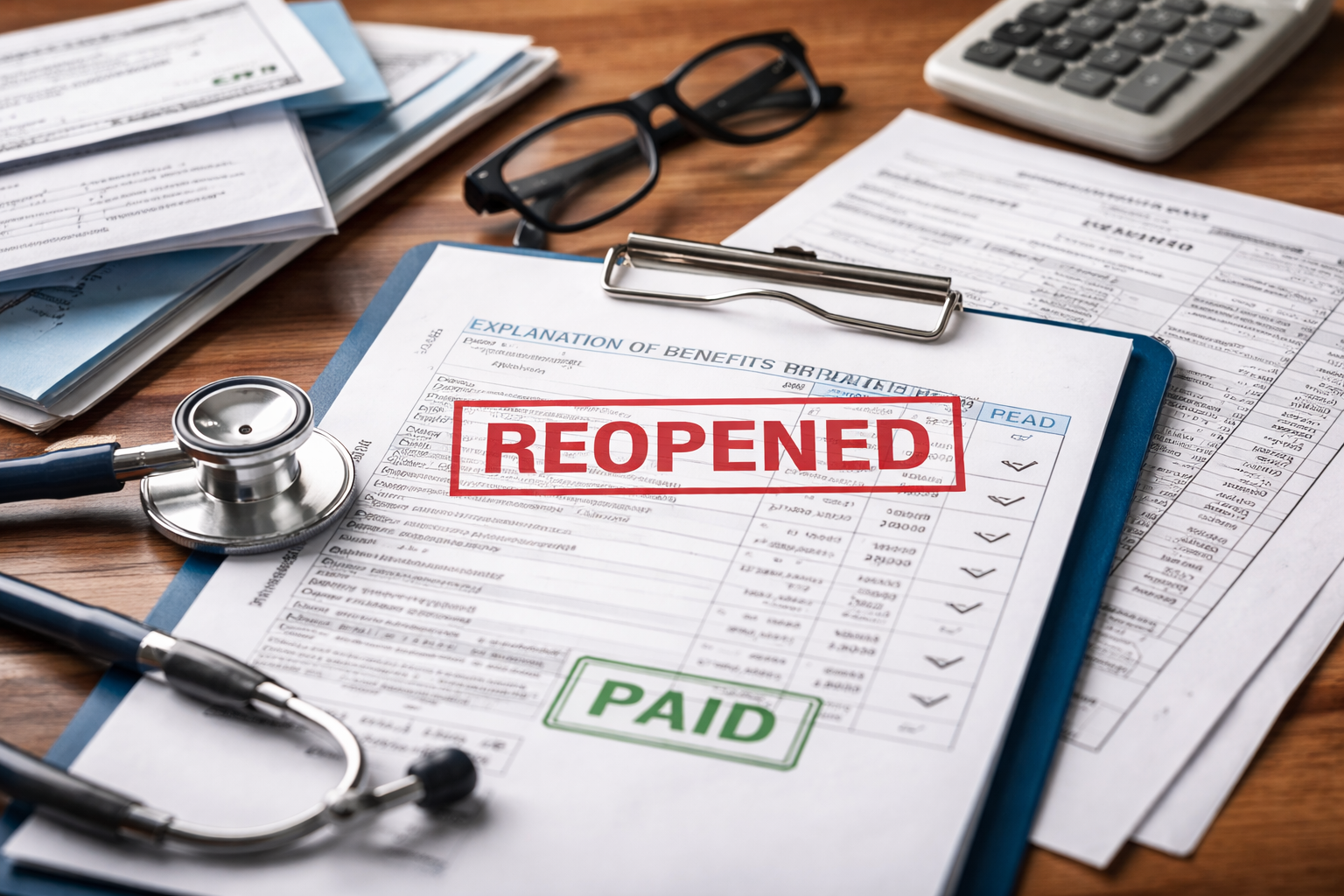
Insurance Claim Reopened After Final Payment — I noticed it because the numbers didn’t match anymore. The claim had been settled weeks ago. The EOB showed “paid,” the provider portal showed a zero balance, and I filed it away mentally as done. Then I logged in to check something unrelated and saw the status changed to “reopened” with a new review date. It was subtle, like a quiet edit to a story I thought was finished.
I called the provider first, expecting them to say it was a system glitch. Instead, the billing rep said, “We got an adjustment notice.” That’s when it stopped feeling like a portal error. When Insurance Claim Reopened After Final Payment appears, the insurer is reopening the decision trail — and money can move backward. The smartest move is to preserve proof while you still can and force the insurer to explain the exact reason code, in writing.
What “Reopened” Usually Means Inside the Claims System
Insurance Claim Reopened After Final Payment typically happens when an internal workflow reactivates the claim file for post-payment handling. The reopening is often triggered by a queue, not a person. Common internal triggers include:
- Post-payment audit sampling (random or targeted)
- Overpayment recovery (recoupment unit flags mismatch)
- Eligibility or coordination changes (coverage data updated after payment)
- Coding edits (modifier, place of service, diagnosis/procedure mapping)
- Duplicate claim detection (system suspects double billing or corrected claim)
The key: reopened is an action state, not a final decision. But it is the doorway to a decision reversal. Insurance Claim Reopened After Final Payment is the point where you want to take control of the paper trail before the insurer’s version becomes the only version.
Freeze the Record Before Anything Changes Again
Before you negotiate, argue, or pay anything, capture what “final payment” looked like. If Insurance Claim Reopened After Final Payment leads to a new determination, older versions can disappear from portals or be hard to retrieve.
Download and save:
- Original EOB showing payment and patient responsibility
- Any provider “paid in full” statement or portal screenshot
- Claim detail page showing dates, billed amount, allowed amount, paid amount
- Any letters about adjustment, review, or audit
Insurance Claim Reopened After Final Payment becomes easier to manage when you can prove what the insurer previously finalized.
If you see audit language or “internal review,” this related page matches that workflow and will help you interpret insurer behavior:
Match Your Situation: The Reopen Type Determines Your Next Steps
Use this self-check to quickly identify what kind of Insurance Claim Reopened After Final Payment you’re dealing with. The category determines whether you focus on medical records, coverage data, or payment math.
Type A – “Adjustment” with small dollar change
Often coding or contract pricing edits. Risk: moderate.
Type B – “Coordination” language appears
Often COB or payer order issues. Risk: high if they reverse large payments.
Type C – “Medical review” or “not medically necessary” appears
Clinical re-review after payment. Risk: high and documentation-heavy.
Type D – “Overpayment/recoupment” appears
Recovery unit seeks money back from provider; provider may bill you. Risk: very high.
Type E – “Duplicate/corrected claim” appears
System thinks a second claim replaced the first. Risk: medium to high depending on provider billing.
Don’t guess. Insurance Claim Reopened After Final Payment is manageable when you force the insurer to disclose which type you’re in.
Type A: Pricing or Coding Adjustment (How to Keep It From Becoming Your Balance)
If Insurance Claim Reopened After Final Payment is a pricing/coding adjustment, the insurer may reduce allowed amounts or reassign portions to deductible/coinsurance. Your job is to confirm whether the patient responsibility actually changed or the provider is just reacting early.
Do this:
- Ask the insurer for the adjustment code and revised EOB date.
- Ask the provider to hold billing until the revised EOB is issued.
- Compare “patient responsibility” line in old vs new EOB.
If patient responsibility didn’t increase, do not pay a new provider bill that contradicts the EOB. Insurance Claim Reopened After Final Payment often creates billing confusion before the final numbers settle.
Type B: Coordination Signals (When It’s Not “Your Fault” but Still Your Problem)
When Insurance Claim Reopened After Final Payment includes coordination language, it often means the insurer believes another payer should have paid first or shared liability. This can trigger reversals.
If your reopening resembles a coordination reversal, this specific scenario is the closest match:
Do this fast:
- Confirm what other coverage the insurer thinks exists (name, policy period).
- Request the payer-order rationale in writing.
- Ask the provider whether they will re-bill the other payer or bill you.
Insurance Claim Reopened After Final Payment in a coordination track is often fixable if coverage information is updated correctly.
Type C: Medical Review After Payment (The Quietest but Most Dangerous Track)
This is the one that feels like a betrayal: Insurance Claim Reopened After Final Payment, and suddenly clinical language appears. Sometimes it’s “medical necessity,” sometimes it’s “documentation,” sometimes it’s “experimental/investigational.”
What to request:
- The clinical rationale or guideline reference used for re-review
- The exact codes under review (CPT/HCPCS/ICD)
- Whether the plan is issuing a new adverse determination
Do not accept vague explanations. Insurance Claim Reopened After Final Payment on a medical review track often comes down to what documentation was (or wasn’t) in the file at the time of adjudication.
Type D: Overpayment and Recoupment (Where Providers Start Billing You)
When Insurance Claim Reopened After Final Payment is tied to overpayment recovery, the insurer’s first move is often to reclaim funds from the provider. The provider may then shift the bill to you, sometimes before you even receive the revised EOB.
Protect yourself like this:
- Tell the provider you will review only after receiving the revised EOB.
- Ask whether a recoupment letter was sent and request a copy.
- Request a billing hold while the insurer’s final determination is pending.
Insurance Claim Reopened After Final Payment does not automatically create a valid patient balance. The balance must be supported by an updated EOB showing patient liability.
Type E: Duplicate or Corrected Claim (When the System Thinks You Were Billed Twice)
Sometimes the insurer reopens because a corrected claim was submitted. The original claim may be reopened to be offset. If Insurance Claim Reopened After Final Payment happened after the provider resubmitted, ask whether a corrected claim exists and whether it replaced the original or was processed as an additional claim.
Your action here is to force one clean story: one service date, one billing record, one final EOB.
Provider vs Insurer: Who Controls What
Insurance Claim Reopened After Final Payment often becomes a blame loop. Providers say the insurer “took it back.” Insurers say the provider “billed incorrectly.” Both can be partly true. Your leverage is knowing what each side controls:
- Insurer controls: adjudication, EOB issuance, adjustment codes, appeal rights timeline
- Provider controls: whether they bill you now, whether they place a hold, whether they resubmit/correct
Ask the provider for a hold; ask the insurer for the written reason code. That is the simplest way to handle Insurance Claim Reopened After Final Payment without getting dragged into noise.
Mistakes That Make Reopened Claims Harder to Fix
- Paying the provider before a revised EOB exists
- Assuming “reopened” means you have no rights because it was already paid
- Waiting until a new denial letter arrives (deadlines can start earlier than you think)
- Sending long emotional messages instead of a short written request for codes and documents
Insurance Claim Reopened After Final Payment is a timing problem as much as it is a money problem.
Official CMS External Appeals Overview
For federal guidance on internal appeals and external review rights after an insurance claim decision, refer to:
Centers for Medicare & Medicaid Services (CMS) – External Appeals Overview
FAQ
Can an insurer reopen a claim after final payment?
Yes. Insurance Claim Reopened After Final Payment can occur due to audit, overpayment recovery, coordination corrections, or coding/eligibility updates.
Does “reopened” mean it will be denied?
Not automatically. It means the insurer is re-evaluating. A new determination may follow.
Should I pay any new provider bill now?
Not until you receive a revised EOB showing confirmed patient responsibility.
What if the provider threatens collections?
Request a hold and document that the claim is under insurer review. Escalate to the provider’s billing supervisor.
What if the claim is reopened after an appeal?
Confirm whether the insurer is reprocessing or reopening. If payment is still wrong after reprocessing, use this related page:
Key Takeaways
- Insurance Claim Reopened After Final Payment is a status change that can lead to recoupment or new patient balance.
- Freeze the record first: save the original EOB and any “paid” confirmations.
- Identify the reopen type (adjustment, coordination, medical review, recoupment, duplicate) and respond accordingly.
- Do not pay new provider invoices until a revised EOB documents patient responsibility.
- Keep requests short, written, and document-focused; timing matters.
Insurance Claim Reopened After Final Payment is unnerving because it feels like a deal being changed after the fact. I remember thinking, “If they can reopen this now, what else can shift later?” What helped wasn’t arguing. It was turning everything into a record: dates, codes, letters, and a clean request for the exact reason the file was reopened.
If Insurance Claim Reopened After Final Payment is showing in your account today, do this right now: download the original EOB, screenshot the reopened status, request the insurer’s written adjustment/reopen reason code, and ask the provider for a billing hold until a revised EOB is issued. Do not pay a new balance, do not accept verbal explanations, and do not wait for a denial letter to start organizing your documents. That sequence protects you immediately and keeps the facts stable while the insurer’s review plays out.