
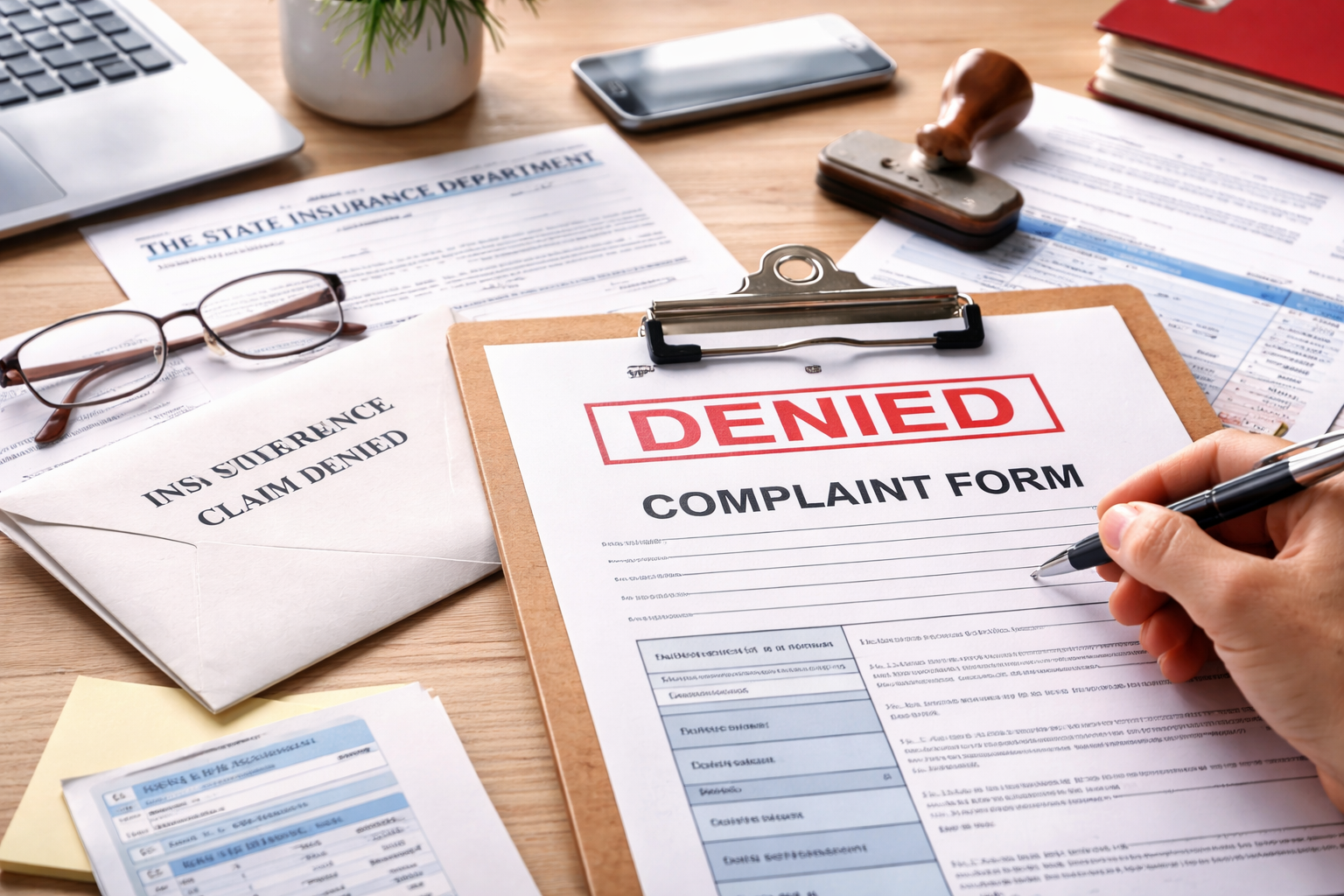
Insurance denied complaint to regulator — that was the phrase I typed after I reread the denial letter for the third time and realized the tone wasn’t going to change. The letter was polished, confident, and oddly vague. It didn’t match the weeks of calls, the appointments, the records I’d already sent. What bothered me most wasn’t even the “no.” It was the feeling that the decision was treated like a routine checkbox, while the consequences were not routine at all.
I didn’t want drama. I wanted clarity: what rule did they apply, what document did they ignore, and why did the “reason” sound like it could fit anyone’s denial? If you’re here, you’re probably in the same spot — you’ve tried the normal path, you’ve gotten a denial that feels too neat, and now you’re searching for the step that forces a more disciplined review. Filing the right complaint doesn’t guarantee an approval, but it can force the insurer to explain itself in a way it can’t casually dismiss.
Before you file anything, make sure you’re not skipping an internal requirement that could weaken your complaint later. This roadmap helps you verify you’re on the correct step for your plan type:
When a Regulator Complaint Is the Right Move
Not every denial is a regulator case. A regulator complaint works best when your issue is about how the insurer handled the claim — timelines, notices, policy interpretation, documentation, and fairness standards — rather than a pure disagreement about medical judgment.
In practice, an insurance denied complaint to regulator is strongest when at least one of these is true:
• You can point to a specific policy section and show it wasn’t applied correctly
• The denial reason changed across letters without explanation
• You have proof the insurer received documents but claims it didn’t
• The insurer missed required response timeframes or failed to provide required notices
• The denial relies on a blanket statement without addressing your submitted records
If your denial feels “template-like,” that’s not a reason to give up. It’s a reason to structure your complaint around what they did (or didn’t) do.
Why Insurers Sometimes Reverse After a Complaint
When you file an insurance denied complaint to regulator, the insurer usually has to respond formally. That changes who reviews your file. Frontline customer service is often replaced by a compliance or executive resolution team. Their job is not to keep the call short — it’s to reduce regulatory risk.
What often happens behind the scenes:
• A supervisor re-checks the policy language that support quoted loosely
• Claim notes are reviewed for contradictions (especially “received” vs “not received”)
• Denial logic is tested for consistency with state rules and the plan’s own procedures
• A settlement approach appears (credit, reprocessing, partial approval, expedited review)
The goal isn’t to “threaten.” The goal is to move your case into the lane where precision matters.
Choose the Complaint Strategy That Matches Your Denial
Use this section like a self-diagnosis. The fastest complaint is the one that matches your denial pattern. An insurance denied complaint to regulator becomes much stronger when you file under the correct “story.”
What it looks like: The denial mentions “not medically necessary” but doesn’t address the physician’s notes, test results, or prior response to treatment.
What regulators care about: Whether the insurer considered submitted documentation, used appropriate criteria, and explained its reasoning clearly.
Best complaint angle: “The denial fails to address specific clinical documentation submitted on [date], and the explanation does not connect policy criteria to the facts of the case.”
What to attach: Denial letter, key clinical note excerpts, submission confirmation, a one-page timeline.
What it looks like: They say no prior auth existed, but you have an auth number, a portal screenshot, or a provider’s confirmation.
What regulators care about: Whether the insurer’s process caused a preventable denial (misrouting, lost authorizations, unclear notice).
Best complaint angle: “Authorization was approved/initiated on [date], but the claim was denied as missing authorization. Please review process accuracy and reprocess.”
What to attach: Auth approval, call log, portal screenshots, claim denial EOB.
What it looks like: The insurer keeps denying for coding mismatch even after the provider corrected and resubmitted.
What regulators care about: Whether the insurer is handling corrected claims fairly and providing actionable guidance.
Best complaint angle: “Corrected claim(s) were submitted on [date(s)] yet denial persists without clear instruction for resolution.”
What to attach: Corrected claim confirmation, denial history, provider resubmission proof.
What it looks like: They say you missed an appeal deadline, but the notice date, mailing date, or portal delivery is unclear.
What regulators care about: Whether the insurer provided required notice and reasonable opportunity to appeal.
Best complaint angle: “The denial notice did not clearly communicate the deadline or was delivered late, making timely appeal unreasonable.”
What to attach: Envelope/postmark (if available), portal timestamp, letter date, your appeal submission date.
What it looks like: The insurer cites an exclusion but doesn’t show how it applies to your specific diagnosis/procedure.
What regulators care about: Clear application of policy language and consistency with plan documents.
Best complaint angle: “The exclusion is cited without explanation connecting it to the covered service requested; request policy interpretation review.”
What to attach: The exact policy page, the insurer’s denial wording, and a short explanation of why the service fits coverage terms.
If you’re unsure which case fits, you can still file — but your insurance denied complaint to regulator will move faster if you choose one primary category and build your packet around it.
The 10-Minute Complaint Packet (What to Gather Before You File)
Regulators don’t have time to hunt through 80 pages to understand what happened. Your goal is to make the core failure visible immediately. Build a “packet” you can upload and reference.
Include these items:
• Denial letter(s) and EOB(s) (most recent first)
• A one-page timeline (dates + what happened + who said what)
• The exact policy section the insurer cited (highlight the relevant paragraph in your own copy)
• Proof of submission (fax confirmation, portal upload receipt, email, certified mail receipt)
• One or two key documents that prove the denial reason is incomplete or wrong (not your entire chart)
Think like an auditor: show the rule, show the action, show the mismatch.
How to File With Your State Insurance Department (Official Directory)
For most private insurance plans regulated at the state level, your state Department of Insurance is the regulator that receives complaints. The simplest official directory is the NAIC list of state insurance departments:
When you file an insurance denied complaint to regulator, your online form will typically ask for:
• Policyholder name and contact info
• Insurer name, claim number, policy number
• A brief description of the issue (this is where your one-page timeline helps)
• Attachments (denial letters, policy section, proof of submission)
Use calm, factual language. Your goal is credibility, not volume.
Complaint Narrative Template (Short, Strong, and Hard to Dismiss)
If you freeze at the “Describe your complaint” box, use this structure. It’s built for an insurance denied complaint to regulator and avoids emotional drift.
Copy/Paste Template:
“On [date], my claim/request for [service] was denied by [insurer]. The denial reason was [quote or summarize]. I submitted [document types] on [date] and received confirmation [how]. The denial does not address key documentation and does not clearly apply policy language to the facts of the case. I am requesting the Department review whether the insurer followed required claim handling standards, provided adequate notice/explanation, and applied the policy consistently. Attached are the denial letter(s), relevant policy section, submission proof, and a one-page timeline.”
This is not legal advice; it’s a formatting approach that improves clarity.
What Regulators Actually Do (And What They Don’t)
People often expect the regulator to “order” the insurer to pay immediately. Sometimes outcomes are strong, but the process is usually more structured.
Regulators commonly can:
• Require the insurer to respond and explain
• Review whether claim handling rules were followed
• Identify procedural violations and require corrective action
• Encourage reprocessing/review under proper standards
Regulators often cannot:
• Replace your doctor or act as a medical board
• Guarantee a coverage approval solely based on need
• Override certain employer self-funded plan disputes the same way as fully insured plans (plan type matters)
If your file is already stuck in “no response” or endless delay mode, read this mid-stream guide to sharpen your next step before you submit the complaint:
In many cases, an insurance denied complaint to regulator speeds things up simply because the insurer must answer on record.
Mistakes That Weaken Your Complaint (Even If You’re Right)
These are the patterns that quietly reduce impact:
• Writing a long emotional story with no policy reference or timeline
• Uploading everything, making it hard to locate the key mismatch
• Filing without showing you attempted the insurer’s stated process (when required)
• Not including claim numbers or identifiers (your case becomes “unmatchable”)
• Mixing multiple unrelated issues in one complaint (pick the strongest, keep it clean)
Your complaint should read like a clear map, not a diary.
FAQ
Is an insurance denied complaint to regulator the same as an external review?
No. External review is typically a third-party review of a claim decision. A regulator complaint focuses on whether the insurer followed rules and handled the claim properly.
Should I file a complaint if my internal appeal is still pending?
If you’re within normal timelines, wait. If timelines are being violated or notices are unclear, you can file to document the delay.
How long does the process take?
It varies by state and complexity. Many consumers hear back within a few weeks, but some cases take longer depending on the insurer response.
Will filing hurt my coverage?
Insurers cannot legally retaliate for a complaint. Keep communication professional and document everything.
What if I missed an appeal deadline?
Read this before you file so you can frame the issue correctly and avoid accidental admissions that weaken your case:
Key Takeaways
• An insurance denied complaint to regulator is strongest when you focus on process, policy language, and documentation handling.
• Build a one-page timeline and attach only the most decisive proof.
• Use the official NAIC directory to find your state insurance department complaint portal.
• Keep the narrative short, factual, and tied to compliance standards.
• File promptly after denial if internal processes are exhausted or timelines are being violated.
Now, do this today: open your denial letter, pull the exact policy paragraph they cite, create a one-page timeline, and file your complaint through the state portal. If your insurer has been treating your case like a template, an insurance denied complaint to regulator forces it into a process where templates don’t hold up as easily.
You’re not asking for sympathy. You’re asking for a fair, rules-based review. And you can start that in one focused hour — with the right packet and the right filing.